Technical Specifications
- Integrated Core Architecture: Dual-Core Real-Time Processor + Xilinx Reconfigurable FPGA
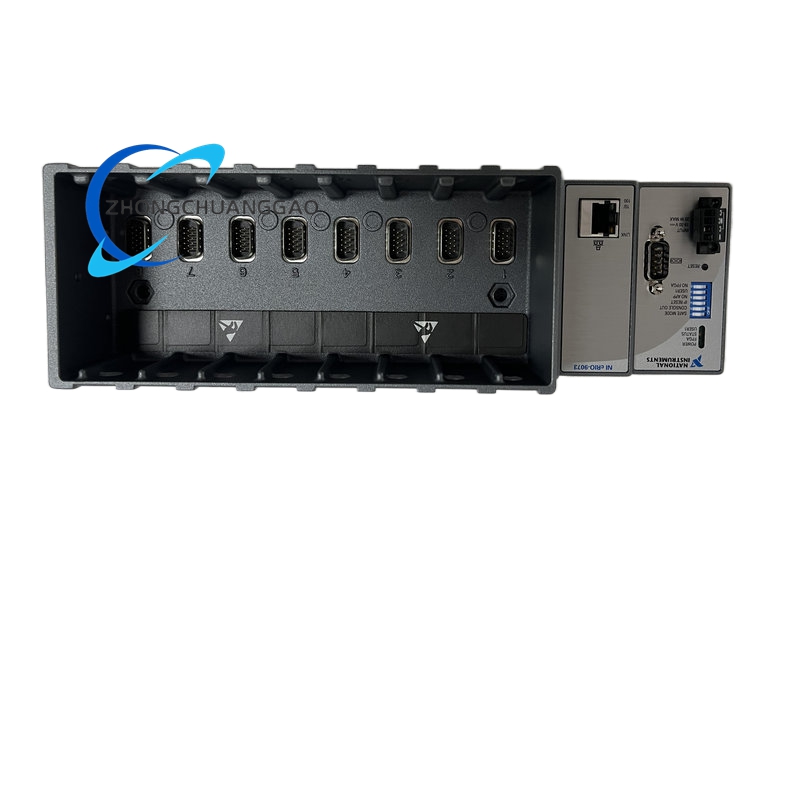
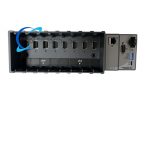
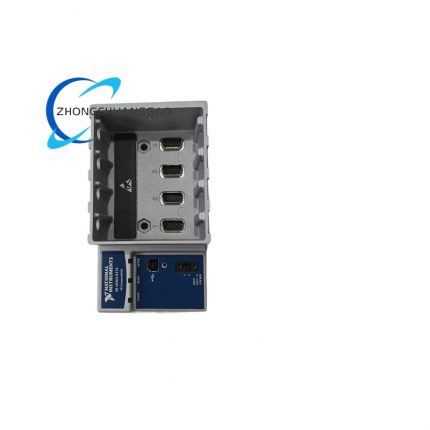
- Built-In C Series I/O Slots: 8 integrated hot-swappable C Series module slots
- Real-Time Processor: Dual-Core ARM Cortex-A9, 1 GHz core frequency
- Onboard Memory: 1 GB DDR3 RAM, 4 GB industrial embedded Flash storage
- Front Panel Standard Interfaces: 2 × Gigabit Ethernet RJ45, 1 × USB 2.0 Host, 1 × RS-232 Serial Port
- FPGA Logic Resource: 28,000 programmable logic cells, 3.8 Mb block RAM
- Power Supply Input: 9 V DC – 30 V DC wide-range industrial DC power, max power consumption 26 W
- Mechanical Form Factor: Compact integrated sealed metal enclosure, desktop/DIN rail dual mounting support
- Bus Standard: NI CompactRIO internal high-speed LVDS FPGA backplane bus
Performance Parameters
- Deterministic Control Loop Latency: < 1 μs FPGA hardware loop response
- Maximum I/O Synchronization Accuracy: 20 ns channel-to-channel synchronous sampling precision
- Ethernet Bidirectional Throughput: 1 Gbps full-duplex per network port
- FPGA Parallel Signal Processing Bandwidth: 800 MB/s internal bus throughput
- Operating Vibration Resistance: 2.5 Grms (10–1000 Hz continuous vibration)
- Operating Shock Resistance: 40 g peak instantaneous impact shock
- Operating Temperature Range: -40 °C to +70 °C
Material Composition
- Outer Enclosure: One-piece extruded 6063 aluminum alloy shell, black hard anodized anti-corrosion surface treatment
- Internal PCB Stack: 10-layer high-Tg FR-4 industrial printed circuit board, analog-digital separated shielding layers
- Heat Conduction Structure: Integrated internal aluminum heat conduction frame connected to outer enclosure for passive heat dissipation
- Connector Components: Gold-plated Ethernet, USB and serial port connectors, gold-plated C Series I/O slot edge contacts
- Mounting Hardware: Stainless steel DIN rail clips and wall-mount fixing bolts
- Internal Storage: Wide-temperature industrial SLC Flash memory chip soldered on mainboard
Structural Features
- All-in-one integrated structure without separate controller chassis; 8 built-in C Series module slots support mixed analog input, analog output, digital I/O and relay modules
- Fanless full conduction cooling architecture; all heat generated by processor and FPGA transfers to external aluminum shell via internal heat frame
- Dual independent Ethernet ports support redundant network communication or separate control/data transmission network isolation
- Full hot-swap support for all 8 C Series I/O modules; module replacement without shutting down the whole controller power supply
- Dual installation structure: standard 35 mm DIN rail snap-on mounting and wall bolt fixing mounting holes reserved on enclosure
- Fully isolated internal power domain between real-time processor, FPGA core and field I/O channels to eliminate ground loop interference
- Front panel LED indicator array for power, running status, hardware fault, network link and FPGA programming state
Working Principle
- Wide-range 9–30 V DC industrial power input enters multi-stage isolated power regulation circuit inside the enclosure, providing independent stable voltage for real-time processor, FPGA chip and each C Series I/O slot.
- Real-time dual-core processor executes high-level industrial control logic, data logging, upper computer communication and fault diagnosis tasks under NI Linux Real-Time operating system.
- Xilinx FPGA chip undertakes low-latency hardware-level parallel signal acquisition, pulse counting, PWM signal generation and high-speed closed-loop control algorithms; realizes nanosecond-level synchronous sampling of all I/O channels via internal LVDS backplane bus.
- Plugged C Series I/O modules directly connect with FPGA bus to collect field sensor analog/digital signals and output control drive signals to on-site actuators.
- Dual Gigabit Ethernet ports transmit real-time process data, alarm information and historical trend logs to external PLC, SCADA, HMI or upper monitoring industrial computer, supporting IP redundancy failover transmission.
- Native compatibility with NI LabVIEW FPGA development environment; users compile customized hardware logic and download to FPGA chip to realize dedicated high-speed measurement and control functions.
Core Function Features
- Integrated dual-core real-time processor + reconfigurable FPGA hybrid architecture balancing high-level logic operation and ultra-low latency hardware control
- 8 built-in universal C Series I/O slots supporting arbitrary combination of voltage, current, thermocouple, strain, digital relay and counter modules
- Fanless passive conduction cooling design suitable for sealed cabinet, outdoor and dust-free explosion-proof control environments
- Dual redundant Gigabit Ethernet ports for fault-tolerant industrial network architecture
- Full hot-swap function of I/O modules to maintain uninterrupted system operation during single-channel module maintenance
- Wide temperature operating range -40 °C ~ +70 °C adapting extreme cold and high-temperature industrial sites
- Deterministic microsecond-level control loop for high-precision motion control, vibration monitoring and power grid signal acquisition applications
- Native complete driver and development tool chain matching LabVIEW, LabVIEW Real-Time and LabVIEW FPGA software platform
Advantage Highlights
- Integrated all-in-one design reduces system assembly steps, eliminates extra backplane chassis procurement cost and cabinet space occupation
- FPGA hardware parallel processing achieves far lower control latency than traditional software PLC, suitable for high-speed dynamic signal testing
- Wide 9–30 V DC power input range adapts unstable industrial on-site power supply without additional voltage stabilizing modules
- Mixed multi-type I/O module compatible slots realize flexible customization of measurement and control channel configuration according to project demands
- Ultra-wide temperature and high vibration resistance meet vehicle-mounted, wind power, mining and offshore platform harsh working conditions
- Redundant dual Ethernet architecture avoids single network cable breakage leading to system communication failure
- SLC industrial Flash storage provides long-term stable data recording without mechanical hard disk failure risk
Applicable Industries
Wind Turbine Condition Monitoring, Automotive Powertrain End-of-Line Test, Power Grid Power Quality Monitoring, Mobile Vehicle-Mounted Test Equipment, Hydraulic & Pneumatic High-Speed Closed-Loop Control, Semiconductor Automation Equipment, Railway Vehicle Signal Acquisition System, Offshore Platform Equipment Monitoring
Installation Requirements
- Two optional installation modes: snap onto standard 35 mm DIN rail, or fix to flat metal wall via reserved bolt holes on enclosure
- Reserve minimum 15 mm clearance on all four sides of aluminum enclosure to guarantee heat conduction and heat dissipation efficiency
- Install controller vertically; avoid horizontal upside-down placement to prevent internal heat accumulation at local position
- Separate Ethernet communication cables and field high-current power cables with isolation distance above 10 cm to suppress electromagnetic interference
- Connect enclosure metal shell to cabinet protective earth terminal via 2.5 mm² copper grounding wire
- Supply DC power source with ripple voltage less than 100 mV peak-to-peak to avoid signal sampling noise interference
Operation & Maintenance Precautions
- Wear ESD anti-static wrist strap when plugging/unplugging C Series I/O modules or connecting internal wiring
- Do not cover aluminum enclosure surface with heat-insulating materials such as foam, plastic film, etc., which will block passive heat dissipation
- When hot-swapping C Series modules, confirm the module lock buckle pops completely to prevent pin bending and short circuit damage
- Regularly wipe aluminum shell dust every 3 months in dusty factories to maintain heat conduction performance
- Firmware and FPGA logic program upgrades must adopt official NI dedicated engineering software; third-party tools are prohibited
- Do not disassemble integrated aluminum enclosure without factory authorization, disassembly will void hardware warranty and calibration certification
- Avoid installing near high-power frequency converters and contactors; additional metal shielding plate is required if installation position cannot be adjusted





Reviews
There are no reviews yet.