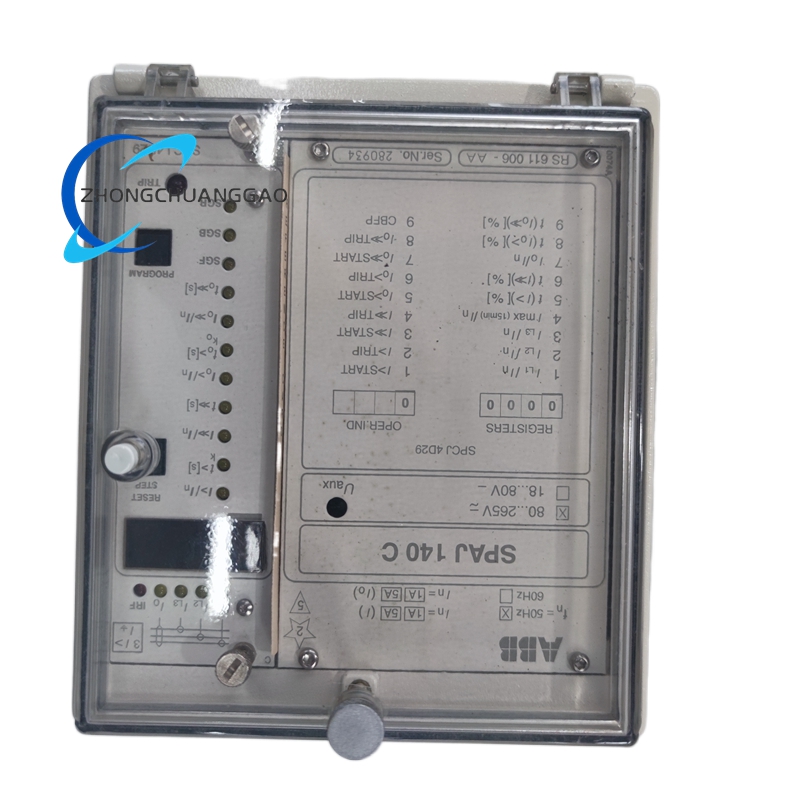
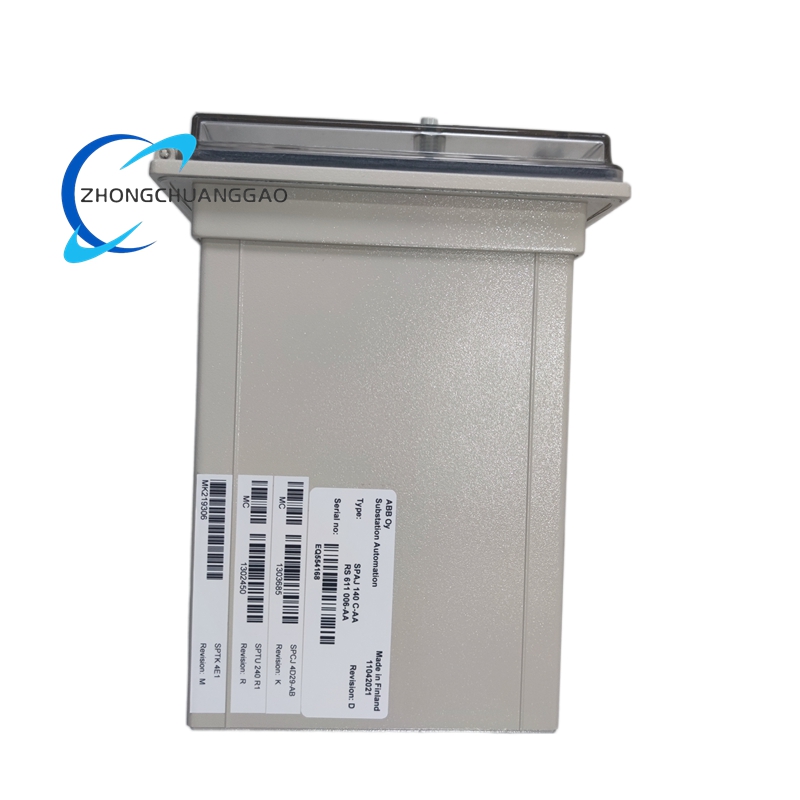
The relay connects to current transformers (CTs) to continuously monitor line currents, automatically isolating faulty sections to prevent equipment damage and ensure grid stability. It is a cornerstone of ABB’s distribution automation concept, offering a cost-effective yet highly reliable solution for feeder protection.
Technical Specifications
The specifications below define the electrical, physical, and environmental parameters of the standard SPAJ140 configuration, particularly the SPAJ140C variant:
- Protection Functions:
- Phase Overcurrent: Three-stage protection (50/51) with instantaneous or definite time delay.
- Earth Fault: Sensitive earth fault protection (50N/51N) with instantaneous or definite time delay.
- Breaker Failure: Built-in circuit breaker failure protection (CBFP).
- Electrical Parameters:
- Rated Voltage: Auxiliary supply typically 24 V DC or 48 V to 250 V AC/DC. Measurement voltage up to 480 V AC.
- Rated Current: CT secondary inputs selectable between 1 A and 5 A.
- Operating Frequency: 50 Hz / 60 Hz.
- Power Consumption: Low burden design to minimize CT load.
- Input/Output Configuration:
- Current Inputs: Three phase currents (L1, L2, L3) and neutral/earth current (Io).
- Output Relays: Matrix configuration including 2 heavy-duty output relays (for tripping) and 4 signal/auxiliary relays (for alarms and indicators).
- Binary Inputs: Configurable for external reset, blocking signals, or remote setting changes.
- Communication Interface:
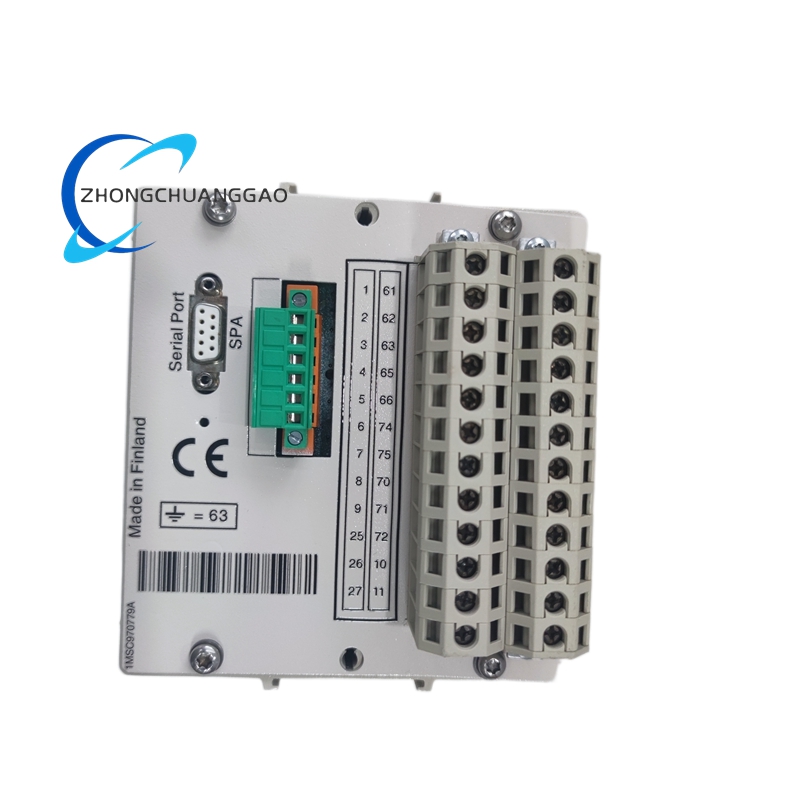
- Protocols: Supports IEC 60870-5-103, Modbus RTU/ASCII, DNP3.0, LON, and SPA bus.
- Physical Layer: RS485 (with optical isolation) and fiber optic options.
- Physical Characteristics:
- Form Factor: Compact DIN-rail mounting or panel mounting.
- Dimensions: Standard relay size (approx. 100mm x 120mm x 80mm).
- Weight: Approximately 0.5 kg to 0.8 kg.
- Protection Class: IP20 (front panel) when installed in a cabinet.
- Environmental Limits:
- Operating Temperature: -25°C to +70°C.
- Storage Temperature: -40°C to +85°C.
- Humidity: 5% to 95% non-condensing.
Functional Features
- Advanced Protection Logic:
- IDMT Curves: Provides multiple inverse definite minimum time (IDMT) curves including Standard Inverse, Very Inverse, Extremely Inverse, and Long Time Inverse, compliant with IEC 60255 and BS 142 standards.
- Definite Time Operation: Instantaneous tripping for high-set faults (I>>) to ensure rapid isolation of severe short circuits.
- Sensitive Earth Fault: Capable of detecting low-magnitude earth leakage currents, crucial for resistance-earthed or impedance-earthed systems.
- Flexibility and Configuration:
- Output Matrix: Programmable relay matrix allows users to route protection signals (start/trip) to specific output contacts based on application needs.
- Setting Groups: Supports multiple setting groups to adapt to changing network configurations (e.g., main/backup feeders).
- Monitoring and Diagnostics:
- Self-Supervision: Continuous internal diagnostics monitor the health of the microprocessor, memory, and power supply.
- Event Recording: Stores fault records, oscillography, and sequence of events for post-fault analysis.
- Digital Display: Local HMI displays real-time current values, settings, and fault data.
- Integration Capabilities:
- Seamlessly integrates with SCADA and DCS systems via standard industrial protocols.
- Supports remote setting and firmware updates via communication ports.
Application Scenarios
The ABB SPAJ140 is a versatile protection device deployed across a wide spectrum of critical infrastructure and industrial sectors:
- Power Distribution Networks:
- Substations: Protection of transformer feeders, bus couplers, and distribution outgoing lines in 10kV to 35kV substations.
- Ring Main Units (RMU): Fault protection in compact switchgear for urban power distribution.
- Industrial Automation:
- Motors and Transformers: Protection of large industrial motors (up to 1500 kW) and step-down transformers against overload and short circuits.
- Capacitor Banks: Protection of power factor correction capacitor banks from inrush currents and faults.
- Process Industry: Chemical plants, pulp and paper mills, and cement factories where process continuity is vital.
- Infrastructure and Utilities:
- Renewable Energy: Grid connection protection for solar inverters and wind turbine transformers.
- Railway Electrification: Protection of traction substation feeders and overhead line sections.
- Water and Wastewater: Pump station motor protection and feeder protection in treatment plants.
- Commercial and Residential Buildings:
- Main incomer protection in high-rise buildings, hospitals, and data centers.
- Protection of cable loops and busbar sections in local distribution boards.
- Specialized Earthing Systems:
- Specifically designed for solidly earthed, resistance earthed (Low Resistance or High Resistance), and impedance earthed networks, making it suitable for diverse grounding philosophies.





Reviews
There are no reviews yet.