
Technical Specifications
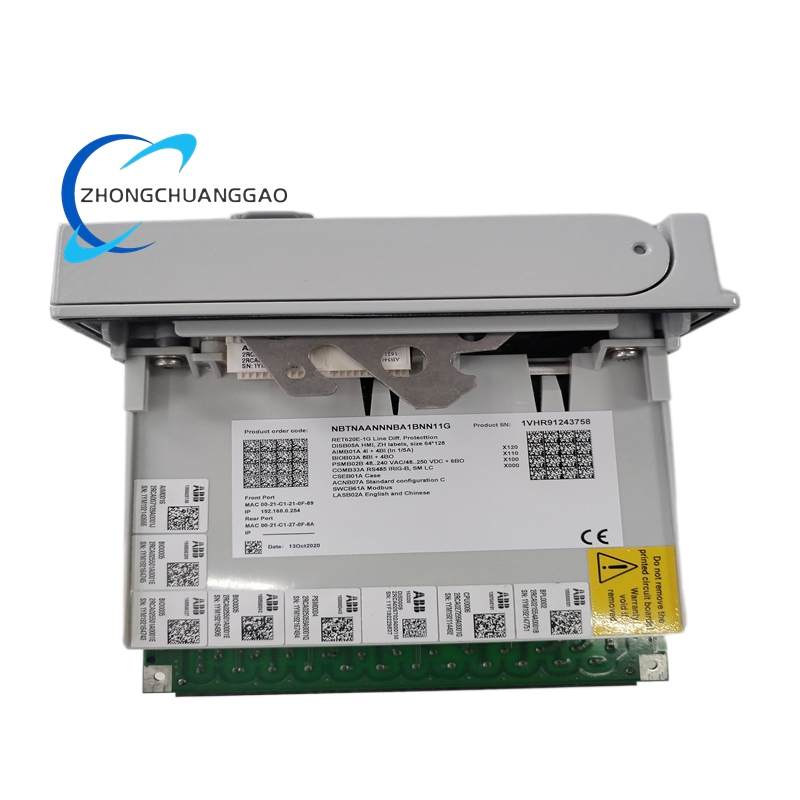
The technical specifications are defined by its functional capabilities, communication standards, and physical design, making it a versatile solution for various distribution networks.
- Protection Functions:
- Time Overcurrent Protection (TOC): Adjustable curves for phased and ground fault protection.
- Instantaneous Overcurrent Protection (IOC): For rapid fault clearing.
- Negative Sequence Overcurrent Protection: To detect unbalanced loads and faults.
- Phase Discontinuity Protection: For detecting broken conductors.
- Breaker Failure Protection: Initiates backup tripping if the primary breaker fails to clear a fault.
- Embedded Loop Control: Performs automatic loop restoration functions to re-energize the healthy part of the network.
- Voltage Metering and Protection: Includes undervoltage, overvoltage, and voltage unbalance protection.
- Communication Protocols:
- IEC 61850: Supports both Edition 1 and Edition 2, including GOOSE (Generic Object-Oriented Substation Event) messaging for high-speed peer-to-peer communication.
- Redundancy Protocols: Supports PRP (Parallel Redundancy Protocol) and HSR (High-availability Seamless Redundancy) for zero-recovery time in case of network failures.
- Other Protocols: DNP3, IEC 60870-5-103, and Modbus®.
- Time Synchronization: Supports IEEE 1588 v2 (Precision Time Protocol) for precise network-wide time synchronization.
- Hardware and Design:
- Drawout Design: Allows for easy and safe withdrawal of the relay unit from its case for maintenance or replacement without interrupting station wiring.
- Scalable Hardware: Features configurable binary inputs/outputs and various communication interfaces to adapt to different application requirements.
- User Interface: Equipped with a large backlit LCD display with a customizable single-line diagram, multi-function keys, and an intuitive menu structure.
- Data Retrieval: Includes a built-in web browser for easy access to settings, sequence of events (SOE), digital waveform recording, and advanced metering data.
Functional Features
- Automatic Fault Isolation and Service Restoration: The relay’s embedded loop control logic automatically isolates the faulted section of the feeder and restores power to the non-faulted sections, often in coordination with other reclosers and switches.
- Flexible Tripping Logic: Supports both single-phase and three-phase tripping, allowing for more precise fault clearing and improved feeder performance, especially on single-phase lateral faults.
- Easy Configuration and Integration:
- Applications such as recloser, switch, and sectionalizer can be easily configured using the Application Configuration Tool (ACT) from the PCM600 engineering and configuration tool.
- Seamless integration into non-proprietary IEC 61850 communication networks, ensuring interoperability with devices from other vendors.
- Advanced Monitoring and Diagnostics:
- Provides detailed sequence of events (SOE) and digital waveform recording for post-fault analysis.
- Comprehensive self-monitoring capabilities to ensure the relay itself is functioning correctly.
- Field data can be easily retrieved through a standard web browser, simplifying maintenance and troubleshooting.
- Cost-Effective and Space-Saving Design: The integrated protection, control, and measurement functions in a single device reduce the need for multiple separate units, saving space, wiring, and overall capital investment.
Application Scenarios
The ABB RET620E-1G is versatile and can be deployed in a wide range of environments and applications:
- Utility Distribution Networks:
- Protection and control of overhead lines and underground cables in primary distribution feeders.
- Automation of ring main units (RMUs) and sectionalizers to create self-healing grids.
- Substation automation for distribution-level feeders.
- Industrial Power Systems:
- Protecting feeders in large industrial plants, such as mining, oil and gas, pulp and paper, and manufacturing facilities.
- Ensuring power quality and reliability for critical industrial processes.
- Renewable Energy Integration:
- Protecting and controlling feeders connected to renewable energy sources like solar or wind farms at the distribution level.
- Harsh Environments:
- The product is designed to operate reliably in extremely demanding environments, including marine and offshore platforms, as well as remote onshore locations.
- Smart Grid and Distribution Automation:
- A core component in projects aimed at modernizing the power grid, improving asset management, and enabling remote monitoring and control of the distribution network.
Reviews
There are no reviews yet.