Technical Specifications PROFIBUS Interface:
- PROFIBUS Mode: DP Slave (DP Device)
- PROFIBUS Functionality: PROFIBUS-DP/DPV1 Slave per EN 50170 extensions; acyclic communication DP-V1 Class 1 and Class 2; acyclic user parameter data and diagnostics up to 237 bytes; Sync; Freeze; Watchdog
- PROFIBUS Baud Rate: 9600 bit/s to 12 Mbit/s, automatic detection
- PROFIBUS Address: 0 to 125
- PROFIBUS Cyclic Input Data: up to 244 bytes
- PROFIBUS Cyclic Output Data: up to 244 bytes
- PROFIBUS Configuration: GSD file provided
CANopen Interface:
- CANopen Mode: Slave
- CANopen Baud Rate: 10 kbit/s to 1000 kbit/s
- CANopen Standard: CiA DS301 v4.02
- CANopen Functionality: PDO, SDO; up to 80 RPDOs and 80 TPDOs; transmission types: PDO Sync, Change-of-State, Event-based, RTR; Network Store/Restore; Heartbeat and Node Guarding
- CANopen Input Data Size: 512 bytes
- CANopen Output Data Size: 512 bytes
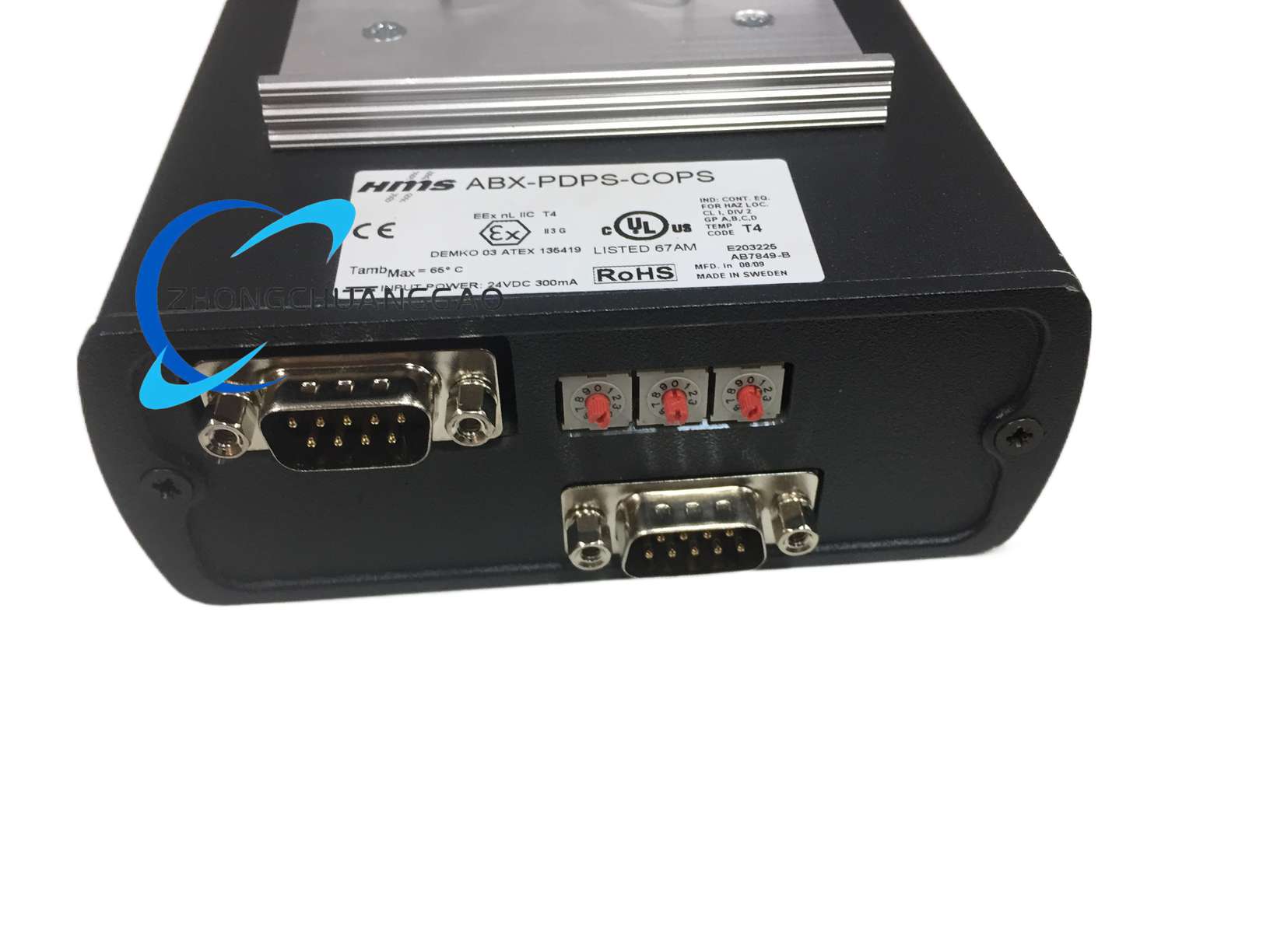
- CANopen Configuration: EDS file provided; on-board rotary switches for node ID and baud rate
- CANopen Connector: 1× D-sub 9-pin male
Power and Physical:
- Supply Voltage: 24 V DC ±10%
- Current Consumption: approximately 100 to 200 mA at 24 V DC
- Operating Temperature: 0 to +55 °C (or -25 to +55 °C by revision)
- Storage Temperature: -40 to +85 °C
- Protection Class: IP20
- Mounting: DIN-rail EN 50022
- Certification: CE, UL, cUL, ATEX (revision-dependent)
- Dimensions: approximately 27 mm × 120 mm × 75 mm
- Weight: approximately 150 g
Functional Features Transparent data exchange between PROFIBUS and CANopen with maximum 512 bytes in each direction on the CANopen side. Supports up to 80 receive PDOs and 80 transmit PDOs for flexible CANopen data mapping. CANopen baud rate configurable from 10 kbit/s to 1 Mbit/s via rotary switch or EDS file. PROFIBUS automatic baud rate detection from 9600 bit/s to 12 Mbit/s. Heartbeat and Node Guarding provide CANopen network health monitoring. DP-V1 acyclic services support parameter access and extended diagnostics. No PLC function blocks or programming required; configuration is done through the Anybus Configuration Manager and GSD/EDS files.
Application Scenarios Interconnection of PROFIBUS-based PLC systems (Siemens S7, etc.) with CANopen-based drives, I/O blocks, sensors, and motion controllers. Used in packaging machinery, printing presses, textile machines, material handling, medical equipment, and automotive test stands where two fieldbus networks must share process data.
Performance Parameters CANopen PDO count: up to 80 RPDO + 80 TPDO CANopen data: 512 bytes input + 512 bytes output PROFIBUS data: 244 bytes input + 244 bytes output Data transfer delay: determined by the slower network cycle time Configuration: via Anybus Configuration Manager (USB) Isolation: galvanic isolation between both network ports and power EMC: EN 61000-6-2, EN 61000-6-4, EN 55022 Class A
Material Composition Blue flame-retardant ABS/PC housing. Gold-plated D-sub 9-pin connectors (PROFIBUS female, CANopen male). Steel DIN-rail mounting clip. PCB with dual network controllers and isolation transformers. Internal DC-DC converters for port isolation.
Structural Features Slim DIN-rail mount housing. One side provides the PROFIBUS D-sub 9-pin female connector; the other side provides the CANopen D-sub 9-pin male connector. Front panel has rotary switches for PROFIBUS address and CANopen node ID/baud rate, status LEDs for both networks, and a 2-pin power connector. Internal dual-processor design runs the PROFIBUS stack and CANopen stack independently, exchanging data through a shared memory interface.
Working Principle The gateway maintains an internal I/O data buffer shared between the two network processors. The PROFIBUS slave interface writes output data from the PROFIBUS master into the buffer and reads input data from the buffer for transmission to the master. The CANopen slave interface maps buffer locations to CANopen object dictionary entries, which are exchanged via PDOs or accessed via SDOs. Data written by the PROFIBUS master appears as CANopen input objects on the CANopen network, and data received from CANopen devices appears as PROFIBUS input data. The transfer is cyclic and fully transparent.
Installation Requirements Mount on a DIN rail inside an IP20 or higher cabinet. Connect 24 V DC power with correct polarity. Connect the PROFIBUS DP cable to the D-sub 9-pin female connector with 120 Ω termination at both bus ends. Connect the CANopen cable to the D-sub 9-pin male connector with 120 Ω termination at both ends. Set the PROFIBUS address and CANopen node ID using the rotary switches. Import the GSD file into the PROFIBUS PLC engineering tool and the EDS file into the CANopen configuration tool. Configure PDO mapping to match the desired data exchange.
Usage Precautions Terminate both PROFIBUS and CANopen buses with 120 Ω resistors at the physical endpoints. Do not exceed the maximum cable length for the selected baud rate on either network. Ensure CANopen node IDs are unique across the network. Verify PDO mapping aligns with the data layout configured on the PROFIBUS side to prevent misalignment. Use shielded twisted-pair cable for both networks and ground shields at one end. Keep the gateway away from high-voltage and high-frequency noise sources. Save configuration files for backup.





Reviews
There are no reviews yet.